
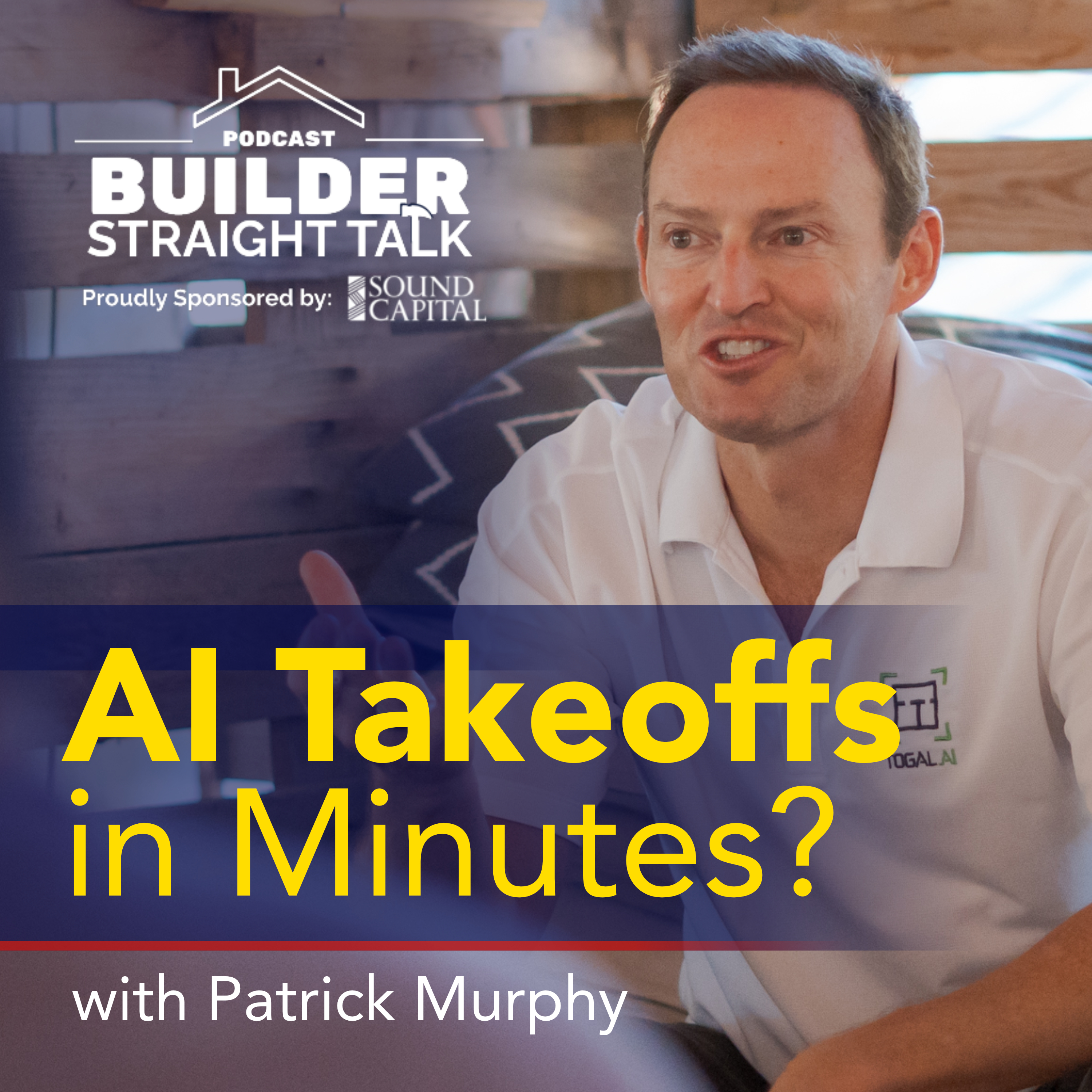
Michael Krisa sits down with Patrick Erin Murphy, whose journey spans finance, politics, and construction innovation. Patrick’s story goes from a CPA and public accountant at Deloitte & Touche to a two-term U.S. Congressman, and now an entrepreneur pioneering AI-driven construction technology and sustainable building materials.
They discuss how AI is reshaping construction estimating, the revolutionary building blocks his company Renco produces, and the challenges and opportunities facing smaller builders in today’s market.
Michael and Patrick’s conversation also touches on education, workforce development, and the future of building in an AI-enabled world.
Early Career and Transition to Construction Innovation
Michael Krisa: Patrick, you’ve had a fascinating career journey. After graduating from the University of Miami with a finance and accounting degree and getting your CPA, you worked at Deloitte & Touche. Can you walk us through how you moved from accounting into construction and politics, and eventually into construction tech innovation?
Patrick Murphy: I grew up around construction through my family’s business, Coastal Construction, where I worked both in the field and office. But I wanted to earn my stripes independently, so I pursued public accounting at Deloitte. I worked with some big clients, including Lennar, which gave me a solid view of homebuilding from a corporate side.
Then the 2008 financial crisis hit, and my plans to work abroad were sidelined. Around 2010, the BP oil spill happened, and being from Florida, I was motivated to help with the cleanup efforts.
That experience opened my eyes to government inefficiencies and inspired me to get involved in politics. I ran for Congress representing Palm Beach, Florida, and served two terms.
After my time in Congress, I returned to the family construction business and realized that while the company had grown, many processes hadn’t evolved.
Estimating was a massive overhead, with 50-60% of the team’s time spent on takeoffs – essentially coloring plans and counting materials. That’s when I thought, if a human can interpret plans, why can’t a computer?
That sparked my journey to automate takeoffs using AI, leading to the founding of Togal.ai, which compresses weeks of work into seconds with improved accuracy.
Michael Krisa: That’s quite the journey – from finance to politics to AI-driven construction tech. What was the biggest lightbulb moment for you in realizing AI’s potential in construction?
Patrick Murphy: The lightbulb really came when I saw how much time was wasted on manual takeoffs. I used to do them with my grandfather, using rulers and printed plans. Today, it’s all digital but still labor-intensive.
I thought, if we can train a computer to recognize different materials, rooms, and quantities from plans, we could save immense time and reduce errors. That’s what Togal.ai does now.
How Togal.ai Works for Builders and Subs
Michael Krisa: For a builder new to Togal.ai, what does the process look like? How does a project go from plans to an AI-generated takeoff?
Patrick Murphy: Our typical users are general contractors and subcontractors, but we also have developers, architects, and owner reps. Companies range from mom-and-pop shops doing a couple million in revenue to giants doing billions.
Users upload PDFs of their plans – anything from schematic sketches to full construction documents. Even a napkin sketch with a scale can work. The system automatically attempts to detect scale, but the user confirms it, since that’s critical.
Within seconds, Togal.ai produces net and gross areas, linear measurements, counts of items like sprinklers and toilets, and classifies rooms (bathrooms, bedrooms, hallways).
Users can customize classifications depending on their trade – flooring companies, drywallers, painters all have different needs.
We’ve integrated large language models too, so users can have a conversational interface with the AI. For example, a painter can ask, “Are there any unique paint types I should watch out for?” The AI can generate scoping documents, RFIs, and help avoid costly misses. One painter caught a ceiling paint omission that saved him $300,000 on a bid.
Michael Krisa: So it’s a dance between the AI and the user, with the human in the driver’s seat?
Patrick Murphy: Exactly. The AI is your co-pilot, doing the heavy lifting and mundane work, but you’re still making the decisions. You review, adjust, and customize the output. It’s designed to be simple – just 19 buttons in the entire tool – and web-based so multiple people can collaborate in real time.
Michael Krisa: What about pricing? Is it accessible for smaller builders?
Patrick Murphy: We keep it simple – $250 per user per month. That’s it. You can use it as much or as little as you want. For small builders, the cost savings alone can pay for the subscription in a month. Some users have told us we should charge more because they’re saving so much money and growing their businesses dramatically.
Michael Krisa: Can you share an example of that growth?
Patrick Murphy: One customer wanted to grow 25%, but within 40 days, they grew 215%. They could bid on more work faster, and their subs could bid faster too by sharing takeoffs. It expanded their capacity and win rate. That’s the power of AI in estimating – it frees up human time to focus on value engineering and winning bids.
The Role of AI and Small Builders in the Future
Michael Krisa: You mentioned the long tail concept and how smaller builders need incentives to adopt AI. Can you expand on that?
Patrick Murphy: Smaller builders are the backbone of the industry – they need every advantage to stay competitive.
AI is not something to fear; it’s a tool that assists. The long tail means it’s better to get a small piece of many projects over time than price yourself out of the market.
Our mission is to help builders grow incrementally – whether it’s going from 10 homes to 25, or 25 to 50 – by giving them confidence through technology and shared knowledge from those who have been there.
Michael Krisa: How do you see AI changing the building process beyond estimating?
Patrick Murphy: AI will revolutionize design, permitting, and construction.
Imagine in five years, you input your address, budget, and style preferences into a prompt. The AI understands local zoning, codes, and builds a compliant design instantly. It can optimize plumbing, electrical, and structural layouts based on hundreds of thousands of past projects. This could compress years of preconstruction into seconds, freeing humans to focus on creativity, sustainability, and community building.
It’s a paradigm shift that could bring productivity in construction back to the levels of the Empire State Building era or better.
Renco: Renewable Composite Building Blocks
Michael Krisa: Shifting gears, tell me about Renco – the company behind your innovative building blocks. What are these blocks made of, and how do they differ from traditional materials?
Patrick Murphy: Renco stands for Renewable Composites. Our blocks are made from recycled glass, recycled plastic, calcite, limestone dust, and a resin binder. They’re designed like LEGO bricks with male and female ends that snap together. They’re extremely strong, lightweight, fast to build with, about 80% greener than traditional materials, and roughly 20% less expensive.
What’s unique is the flexibility – we can produce blocks from 2 inches to 48 inches or any size in between, tailored to your design. It’s not prefab or modular in a restrictive sense; you get a custom block configuration for your project.
Michael Krisa: That sounds revolutionary. How did you get this material approved, given it’s a new building material?
Patrick Murphy: It took 10 years and 450 tests to get it approved. We underestimated the regulatory rigor because construction historically relies on three main materials – wood, concrete, and metal. We introduced a fourth, so the scrutiny was intense but necessary for safety.
Our blocks are fire-tested, hurricane-resistant (Miami-Dade approved), termite-proof, mold-free, and durable even after years submerged in water. They also offer excellent insulation and seismic performance.
Michael Krisa: How does the building process work for someone using Renco blocks?
Patrick Murphy: You start with your design or schematic plans and bring them to us. We analyze and optimize the layout for our block system and provide you with a block count and budget. The blocks arrive color-coded by piece, ready to assemble on-site with glue and a rubber mallet – no heavy equipment needed.
The heaviest piece in a recent 96-unit apartment project was only 80 pounds. Skilled labor is not required; in fact, one person built a 1,500-square-foot house alone in a day.
The blocks have hollow channels for running electrical and plumbing, and repairs are as simple as cutting drywall – no structural damage.
Michael Krisa: What about finishing? Do builders still need drywall?
Patrick Murphy: Drywall is optional. In some projects, like in the Middle East, we’ve used a roll-on paint finish directly on the blocks both inside and out. It looks great, meets code, and eliminates the need for drywall. That’s a huge benefit for disaster relief or affordable housing where speed and simplicity matter.
Michael Krisa: How does Renco compare cost-wise to traditional wood or concrete construction?
Patrick Murphy: Currently, it’s about 20% less expensive on a per-square-foot basis, not including savings from faster build times and reduced financing costs. The labor is less skilled and faster, which compounds savings. As we scale and improve manufacturing, costs will come down further.
Challenges and Opportunities in Construction and Education
Michael Krisa: You’ve been outspoken about the state of education and the trades. What are the biggest issues, and how do you see AI playing a role?
Patrick Murphy: We’ve created a culture that undervalues trades and overemphasizes traditional college paths, often leaving young people burdened by debt and without practical skills. We need to bring back tactile education – shop class, home ec – and teach entrepreneurship, basic finance, and critical thinking.
AI isn’t something to fear. It’s a tool that will automate mundane tasks and free people to focus on creativity and problem-solving. But to use AI effectively, you need to be a critical thinker who can ask the right questions.
Education needs to pivot toward developing those human skills like communication, creativity, and collaboration.
Michael Krisa: What about the workforce shortage in construction?
Patrick Murphy: It’s a huge challenge. For every five builders retiring, only about one and a half enter the trades. We’re behind the curve, especially if we aim to build a million homes a year. That’s why innovations like Renco blocks and AI estimating are vital – they reduce reliance on skilled labor and speed up construction.
The Future: Collaboration, AI, and Building Smarter
Michael Krisa: Do you envision a future where builders collaborate through AI platforms?
Patrick Murphy: Absolutely. We’re working toward AI that can recommend design improvements based on millions of buildings worldwide. Builders, architects, and tradespeople can collaborate openly, breaking down legal silos and communication barriers. This will reduce RFIs, change orders, and bid busts by solving problems upfront.
Michael Krisa: How do you see the building industry evolving in the next decade?
Patrick Murphy: We’re at an inflection point. Construction productivity has been flat for 50 years, but AI, robotics, and new materials will drive a quantum leap. I believe in five to ten years, you’ll be able to design and approve a building with a prompt, and have it built faster, cheaper, and greener than ever before.
Reflections on Politics, Society, and Personal Life
Michael Krisa: Having served in Congress, you’ve seen firsthand the frustrations of governance. How did that experience shape your outlook?
Patrick Murphy: I went in naive, hoping to solve problems. But I quickly saw partisanship and incentives that reward division over collaboration. The lack of personal relationships among lawmakers and the pressure to get reelected creates dysfunction.
I wrote a book, A Divided Union, to explore these issues and propose incentive structures to encourage problem-solving.
Michael Krisa: On a lighter note, how do you unwind?
Patrick Murphy: I love the outdoors – boating, fishing, diving. I play paddle tennis and try to spend as much time outside as possible in South Florida. It’s a great way to reset and recharge.
Michael Krisa: Before we wrap, if you were at St. Peter’s Gate and he asked what you haven’t done yet, what would you say?
Patrick Murphy: I’d say, “Transform the built environment.” Housing is a basic human need, and I want everyone, especially those in need, to have a sustainable, healthy home they’re proud of. We have a long way to go, but it’s a goal worth pursuing.
To learn more about Patrick’s work and the future of building smarter, stay tuned to Builder Straight Talk.

0 Comments