
When Tanya Cromwell couldn’t find a house design she liked in 1995, she taught herself AutoCAD and started building. Nearly three decades later, she’s a partner at Caddis Builders in Idaho, running operations for a company that builds 25+ homes annually while mentoring the next generation of construction leaders.
Tanya’s path offers practical insights into an industry facing serious workforce challenges. With five workers retiring for every one entering the trades, and women representing just 10% of the construction workforce, her perspective on talent development, company culture, and sustainable business practices offers a great example for builders navigating today’s competitive market.
In this conversation with Michael Krisa, Tanya shares specific strategies that have worked – from paying subcontractors weekly to retain loyalty, to creating ownership pathways for young employees, to financing spec homes without bank loans.
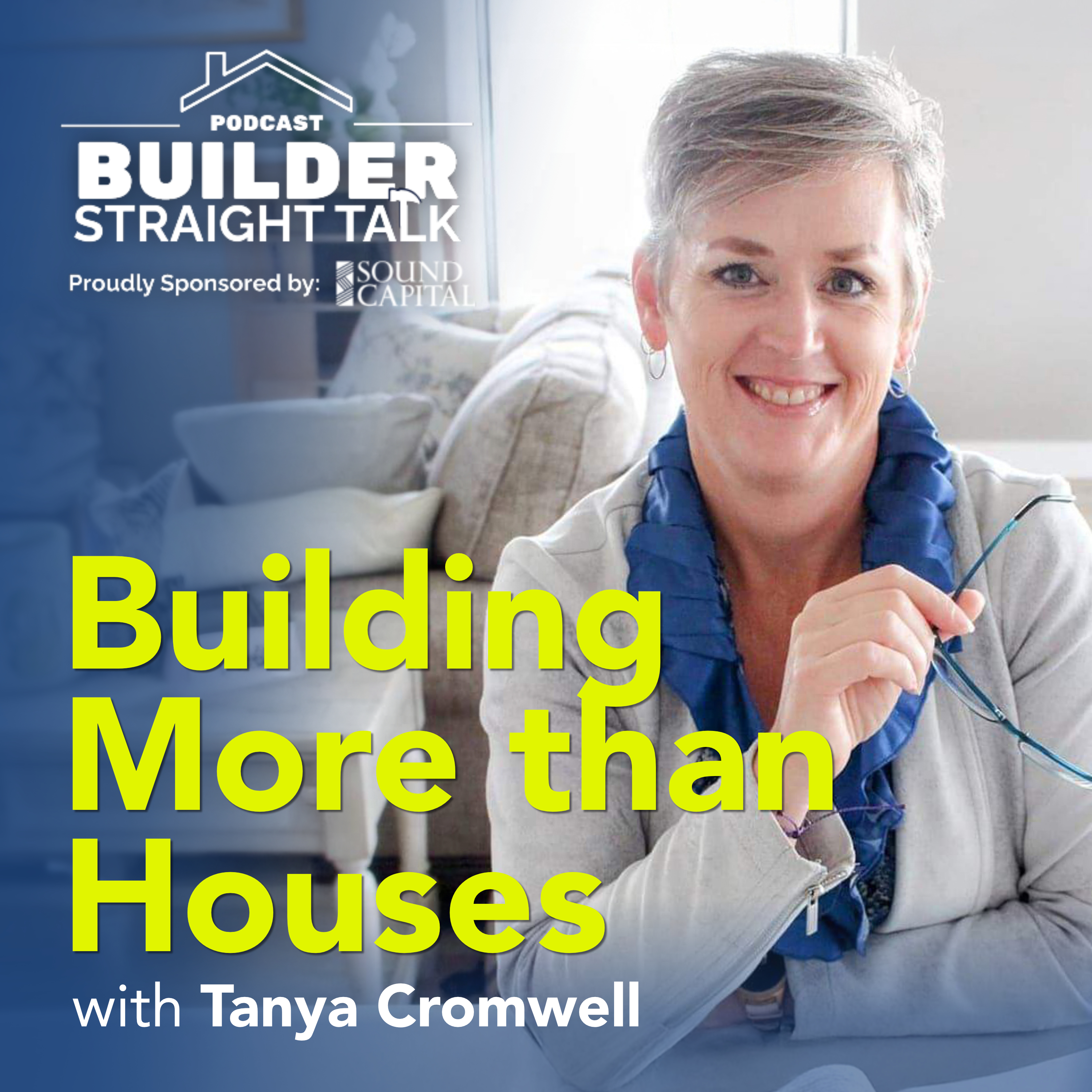
Michael Krisa: Tanya, how does someone as petite and blonde as you, with no tattoos :), end up becoming such a successful builder in a traditionally male-dominated industry?
Tanya Cromwell: Thanks, Michael. It’s been quite the journey, and honestly, it’s been a life of learning, education, and a can-do spirit. I started back in 1995 when my husband and I decided to build our own house. I couldn’t find a design I liked, so I thought, why not design my own? That led me to teach myself AutoCAD and drafting since Idaho doesn’t require you to be an architect to do residential design.
From there, it really became a passion. I wasn’t just sitting behind a computer; I was out on job sites, learning from the ground up, combining design with construction. I was raised around boys – 14 cousins who were all boys – so being “one of the guys” never felt unusual.
There were no builders in my immediate family except an uncle who was a commercial builder, but residential building was new territory for me. I just always loved working with my hands and tools. It was a natural fit.
Michael Krisa: That’s fascinating. It’s interesting you mentioned you didn’t go to school for architecture – what did you study?
Tanya Cromwell: Believe it or not, I went to school for dance. I was going to be a dance teacher and even had my own studio with about 300 students. But when I got pregnant, I realized that the hours wouldn’t work for my family life. I loved performing but didn’t enjoy teaching as much.
So, when my kids were young, I stayed home but needed a creative outlet. Designing and building our house gave me that outlet and eventually turned into a career.
Michael Krisa: It sounds like your upbringing and early experiences really shaped your approach. Do you think the trades have a stigma for young people today? How do you see that evolving?
Tanya Cromwell: Absolutely, there’s a stigma that trades are a fallback for those who aren’t “smart enough” for college. I was guilty of that mindset with my own kids, pushing them towards degrees. But the narrative is shifting.
For example, in Idaho, our governor offers grants to kids to attend trade schools, which is helping change perceptions. However, we need to start even earlier – elementary school age – to show kids that working with tools and building things is a valid and rewarding career path.
Kids often say they want to be doctors or astronauts, but if we can get them excited about trades early on, that can open doors and create opportunities they might never have considered. Removing shop class from schools was a big mistake, in my opinion. Hands-on experience is essential.
Michael Krisa: That’s a great point about starting early. Let’s talk about your company. How did you get involved in Caddis Builders, and what’s the story behind that partnership?
Tanya Cromwell: While I was designing houses, one of the contractors I worked with approached me because none of his kids wanted to take over his company. He asked if I wanted to partner up and start a construction company. I said yes, and that was about 20 years ago. We built high-end custom and spec homes – about 25 a year. I learned a ton from that partnership; it was like paying for an education.
Four years ago, when my partner retired, I teamed up with a couple of other partners and started a new company, Caddis Builders. We focus on multifamily, single-family developments, and some commercial projects. We’ve been growing steadily for the last three and a half years.
Michael Krisa: How competitive is the Idaho market right now for home building?
Tanya Cromwell: It’s very competitive. The market across the US has slowed down, but Idaho is about six months behind other states. We’ve been the fastest-growing state for five years straight, with many people moving here post-COVID for the lifestyle and outdoor amenities. That influx keeps demand strong for both multifamily and single-family housing.
Michael Krisa: What role do you play at Caddis Builders, and what’s your specialty?
Tanya Cromwell: I’m one of the partners and owners. My specialty is operations – I oversee the day-to-day running of the company, client interface, and project execution. I still enjoy doing design work in the evenings as a separate passion, but my main role is making sure the company runs smoothly and successfully. We also focus on mentoring young people in the company to prepare them for leadership roles. I teach them how to run a successful construction business, while my partners focus on accounting and finances.
Michael Krisa: Speaking of mentoring and leadership, do you have an exit strategy for the company?
Tanya Cromwell: Yes, we have a clear plan. Many builders don’t, and that’s a big missed opportunity. We’ve identified three or four promising young employees who have the potential to take over.
We incentivize them by giving them ownership through dividends and bonuses that they can use to buy shares in the company over a 10-12 year period. This way, they have “skin in the game” and feel like the company is theirs. It motivates them to work hard and stay invested in the company’s success.
We also brought on a framing crew from a guy who was struggling with the business side. Rather than letting him fail, we hired his entire crew as employees, took the bookkeeping off his plate, and gave him a stable income. It’s about knowing people’s strengths and setting them up for success.
Michael Krisa: That’s a brilliant approach – aligning ownership with performance and motivation. How do you manage the financial side of things, especially since you’ve headhunted talent from banking and accounting?
Tanya Cromwell: I’m creative and hands-on, but I’m not a fan of accounting. So, I brought in a partner with an accounting background to manage the finances. I focus on operations and design, and they handle money. It’s vital to recognize your weaknesses and fill those gaps with the right people. You can’t do everything yourself, and trying to be a control freak will only hold your business back.
Michael Krisa: How many employees and subcontractors do you have at Caddis Builders?
Tanya Cromwell: We just hired our 18th employee, including project managers, superintendents, foremen, and site workers. We don’t self-perform much work; instead, we work with around 200 subcontractors for framing, roofing, and other trades. Managing relationships with subcontractors is crucial in this competitive market.
Michael Krisa: In such a competitive market, how do you keep your subcontractors loyal and ensure they show up on time?
Tanya Cromwell: We always have an A subcontractor and a B subcontractor for each trade. The B contractor is always trying to become the A, so there’s healthy competition.
We also pay our subcontractors weekly, which is unusual in the industry.
Most builders pay monthly after bank draws, but we’ve structured our cash flow so we can pay weekly. That’s a big incentive for subcontractors to stay loyal and prioritize our projects.
Michael Krisa: Are you using any new building technologies or materials, or are you sticking with traditional stick framing?
Tanya Cromwell: Mostly traditional stick framing, but we’ve experimented with SIP panels and prefab walls. Unfortunately, the technology isn’t widely available in Idaho, and shipping prefab materials from four hours away isn’t cost-effective. Our framers build walls off-site on trailers and then raise them on-site to speed up the process.
Michael Krisa: There’s also exciting innovation happening in 3D-printed homes and modular construction.
I recently interviewed Patrick Murphy, a former congressman who’s involved in building homes with composite limestone concrete blocks that snap together quickly. Within a day, you can assemble a house with minimal heavy equipment. This kind of technology will help address labor shortages and change the way we build homes.
Michael Krisa: Speaking of labor shortages, how do you see the future of the workforce in construction?
Tanya Cromwell: It’s a real challenge. For every five workers retiring, only about one new person enters the trades. That’s why we’re so focused on bringing young people into the industry and mentoring them. The National Association of Home Builders and other organizations are working on this too.
We also need to bring more women into construction. Women make up only about 10% of the industry. There’s still stigma and prejudice, especially from parents who worry about their daughters entering the trades.
On job sites, men often feel nervous about how to interact with women, and there’s a need to create a respectful and inclusive culture.
But the physical differences between men and women can be addressed with proper tools and equipment. Empowering women and creating opportunities is critical for the future workforce.
Michael Krisa: How do you personally handle leadership and company culture to ensure inclusivity and respect?
Tanya Cromwell: It starts at the top. As the owner, I set the tone that everyone is valued equally regardless of gender or background. We focus on skills and getting the job done. If a woman can’t carry heavy bags of concrete every day, we find tools or equipment to help. For example, shoulder harnesses or wheelbarrows can make a big difference. It’s about adapting and empowering people to succeed.
Michael Krisa: How do you position Caddis Builders to stand out in such a competitive market?
Tanya Cromwell: Twenty years ago, being the only female builder was a unique selling point. But now there are many women builders, so that’s no longer enough.
Our real advantage is having a team of employees who are smarter than I am and who care about the company as if it’s their own. They’re passionate and represent the company with pride.
When you have 18 people who believe in the company, that passion spreads and helps differentiate us.
Michael Krisa: For builders in other states looking to differentiate themselves, what advice would you give?
Tanya Cromwell: First, identify your company’s strengths – whether it’s speed, quality, energy efficiency, or healthy homes – and focus on being the best in that area.
Then, develop a clear, concise elevator pitch.
You should be able to tell a potential client in 30 seconds what you do and why you’re different. If you can’t, you’ve lost them.
It’s also important to take quiet time, put away distractions, and really reflect on what your company does well and what sets you apart. Then communicate that clearly to your market.
Michael Krisa: You mentioned mentoring earlier. How important is mentoring to you, and what have you learned from it?
Tanya Cromwell: Mentoring is a two-way street. I’ve learned as much from the young people and entrepreneurs I mentor as they’ve learned from me. They bring fresh perspectives, new ideas, and knowledge about social media and marketing that can improve processes.
For example, interns from local colleges have simplified complex systems in our office in seconds. It’s vital to keep an open mind and learn from the next generation.
Michael Krisa: Let’s talk about capital. How do you approach financing spec homes and larger developments?
Tanya Cromwell: I’m proud to say that I’ve never taken a bank loan to finance spec homes. I personally finance spec homes, and the company earns the contractor’s fee and profit. Cash flow is critical, and borrowing money at high interest rates can be risky, especially with volatile markets. For spec homes, I advise builders to find investors like doctors or dentists who want to diversify their portfolios. Building specs for investors keeps your business running without taking on too much financial risk.
For larger developments, like the 370-home subdivision I’m currently building, we work with investment groups who own the homes and handle sales.
We focus on delivering quality homes quickly – our build schedule for specs is around four months, which is fast. That way, investors can make money, and we stay focused on what we do best.
Michael Krisa: You’ve clearly built a successful business and leadership style. What’s the one thing you’re most proud of in your career?
Tanya Cromwell: I’m most proud of being able to take care of my parents. I was born and raised in Idaho, and we didn’t have a lot growing up. My parents lived in the same trailer house for 50 years. About three and a half years ago, I started building a new house for them. Unfortunately, my dad passed away before moving in, but I was able to promise him I would take care of my mom. Now she lives next door to me in a brand-new home with no worries.
That’s the real reward of this career – being able to provide for your family and keep your promises.
Michael Krisa: Tanya, this has been an incredible conversation. Thank you for sharing your insights and experiences. I look forward to doing a part two to dive deeper into mentoring and getting more women into the trades.
Tanya Cromwell: Thank you, Michael. I appreciate the opportunity and enjoyed the conversation.

0 Comments