
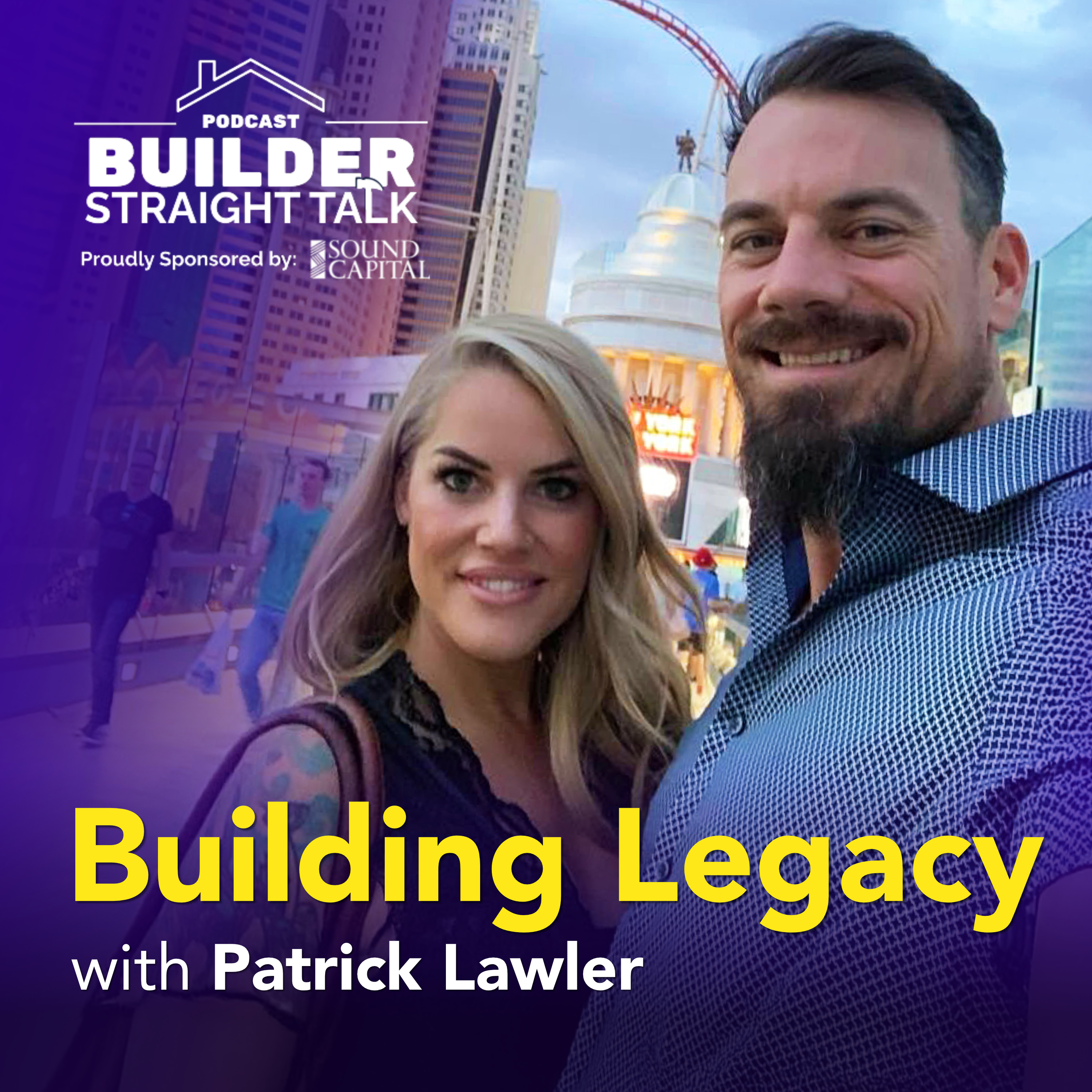
In this episode of Builder Straight Talk, host Michael Krisa welcomes Patrick Lawler, Vice President of Lawler Construction, Inc., to discuss his journey from professional baseball player to construction industry leader.
As the son of company founder Jim Lawler (featured in the very first episode of our podcast), Patrick shares insights on family business dynamics, faith-based leadership, and the evolving challenges facing the construction industry.
Michael Krisa: When I spoke to your dad and to you, you guys get this glitter in your eye when you talk about what you do – the whole aspect of building. It’s such a unique feeling. Imagine driving by a neighborhood and telling your son, “We built that.” That impact on family and community must be a powerful gift. How does that feel to you?
Patrick Lawler: That’s a good point. I love looking at the projects we’ve completed. But beyond that, I often think about the employees and their families who are impacted by the work we do. I try to imagine how many people are involved in each home – the laborers, painters, drywallers, their families – and how we provide consistent work that supports them. That’s something we really value and try to honor. It motivates us to maintain quality because we know so many lives depend on it.
From Baseball Dreams to Building Homes
Michael: Let’s start at the beginning. I interviewed your dad a while ago, and he’s a salt-of-the-earth kind of guy. Was it always in the stars for you to become a builder, or did you have other dreams?
Patrick: Honestly, it wasn’t in the plans at all initially. I went to college on a baseball scholarship and played professionally in the minor leagues for a few years. Baseball was my dream. But growing up, I worked summers on job sites with my dad, so I had some exposure.
When I met my wife, family became a priority, and baseball took a backseat. During the recession, I worked with my dad on remodels and learned quickly. I fell in love with the work, and that’s when I decided to make building my full-time career.
Michael: So it was a passion you grew into rather than something you were born into?
Patrick: Exactly. At first, I was just a laborer and struggled with the early mornings and schedule. But as I moved into superintendent and estimator roles, I loved bringing imagination and quality to projects. Making homes function better, be more cost-effective, and higher quality – that’s what hooked me.
Michael: Did your dad expect you to eventually take over the company, or was it more like you were an employee who loved what you did?
Patrick: At the beginning, it wasn’t about grooming me to run the company. My dad always wanted us to pursue something bigger than what he had. He started the company without a college education, got his GED, and built a successful business. He hoped we’d find something better. But as time went on and we proved our value, he realized having us involved was a positive for the company.
Michael: So it wasn’t about legacy at first, but more about opportunity?
Patrick: That’s right. He wanted better for us, not necessarily for us to follow in his footsteps. But now, with what we’ve built together, it’s hard to imagine a better path.
The Lawler Group: Quality Over Quantity
Michael: You guys are within the top two percent of builders in Arizona by volume, right?
Patrick: I’d say we’re close. Volume is one thing, but quality is first and foremost for us. We’re not about tract or production building. Every subdivision home we build is semi-custom – we adjust layouts, add bathrooms, customize elevations. We focus on quality over sheer numbers.
Michael: What’s your typical project mix? Are you building custom homes, spec homes, rentals?
Patrick: It’s a mix. We do mostly semi-custom homes. Clients come to us before they have a lot picked out, and we help them select land that fits their needs and budget. Others come with plans or have had a bad experience with another builder. We can step in before ground is broken and take over. We’re flexible and do everything from land acquisition assistance to design and construction.
Michael: Stepping in after another builder falls through sounds tricky. How do you manage the client’s expectations and build trust?
Patrick: It’s a challenge because most clients have heard horror stories about contractors. We’re upfront about what to expect. We show them previous contracts and final invoices to demonstrate transparency.
Our motto is “100% transparency to the nth degree” and “underpromise and overdeliver.” We want to beat timelines and budgets consistently.
Michael: Do you have a process for setting expectations with new clients?
Patrick: Yes. Early on, we paint a realistic worst-case scenario, especially after the pandemic exposed supply chain issues, price increases, and subcontractor shortages. We want clients to understand potential delays or cost changes upfront.
Word-of-mouth and referrals are vital for us, so ensuring clients are happy at the end is more important than just winning the contract.
Managing Change Orders and Cost Controls
Michael: Change orders are often a source of stress. How do you handle them?
Patrick: We set contingency allowances in our contracts to cover unforeseen costs like price hikes or unexpected site conditions. Our subcontractors help assess risks upfront.
Over the last four years, we haven’t exceeded our contract amounts unless a client chooses upgrades. If we don’t use the full contingency, the savings go back to the client. We send detailed expense reports to clients showing every cost plus our margin.
Michael: That level of transparency is rare. How do suppliers and subcontractors react to sharing their quotes with clients?
Patrick: Some suppliers are hesitant because they’re used to marking up prices for contractors. But our team tracks costs meticulously – down to the hour and the penny. It requires honesty and accountability from everyone, but we’re fortunate to have a team that embraces this approach.
Nothing is too small and nothing’s too big, as long as it’s new construction, I feel like we’re the right pick for anybody who’s looking for quality and not just the bottom dollar.
Faith and Values in Business
Michael: Your dad shared a powerful story about a moment when he felt his back was against the wall and turned to God. Do you share that spiritual outlook in running the business?
Patrick: Absolutely. Having faith helps us manage the stress of this unpredictable industry. We start every meeting with a prayer.
We believe God is in control, which lifts a lot of pressure off our shoulders. Mistakes happen, clients change their minds, but we trust that everything happens for a reason. It’s not about hoping God does the work for us, but about doing our best and trusting the outcome.
Michael: Does this faith-based approach affect who you hire or partner with?
Patrick: Yes and no. We make it clear from the start that our company culture is faith-based. If someone isn’t comfortable with that, it’s okay. We want people who respect our values and can work within that environment. Most clients and employees appreciate the honesty and integrity this brings.
Setting Boundaries with Clients and Projects
Michael: Have you ever had to turn down clients because their expectations were unrealistic?
Patrick: More often than you’d think.
About 40% of initial conversations reveal a disconnect between what clients want and what their budget can realistically achieve.
Sometimes it’s a geographic cost difference too – homes cost more here due to labor, shipping, and living costs. If we sense a mismatch early, we’re upfront about it. It saves time and stress for everyone.
Michael: I tell clients, “I’d rather turn you down than let you down.” Does that resonate with you?
Patrick: Definitely. If I dread working with someone, it’s not good for anyone. We want to start each day excited about the work ahead, not burdened by friction.
Leadership and Growth in the Company
Michael: What’s your current role and how did you get there?
Patrick: I’m the vice president. I started as a laborer, then became superintendent, estimator, and project coordinator. I’ve overseen estimating teams and superintendents as we grew. Now I manage overall operations.
We have about 17 to 20 employees, including superintendents, estimators, an interior designer, an architect, office staff, laborers, and a warranty manager.
Michael: Do you miss swinging a hammer?
Patrick: Sometimes. I try to get on job sites when I can, but office work and family take priority. I’m also a baseball coach for my kids, so that keeps me busy.
Balancing Family, Coaching, and Business
Michael: You mentioned coaching baseball. Tell me about your kids and if they’re interested in following your footsteps.
Patrick: I have three kids – 17, 13, and 10. They’re all athletes and good students. Like my dad, we encourage them to pursue their dreams, but I see glimpses of interest in building. They’re proud of what we do. If they don’t play sports, they’ll have summer jobs with us. The trades face a labor shortage, so encouraging the next generation is important.
Michael: You hit on a key issue – the labor shortage. What’s your take on that?
Patrick: It’s a tsunami waiting to happen.
For every five tradespeople retiring, there’s only about one replacing them. Demand exceeds supply, so wages rise and skilled workers can be selective. We need to get kids interested early, maybe starting in grade school.
Hands-on play and building skills are critical. The disconnect today is that many kids grow up on screens rather than with tools, and that stunts imagination and skill development.
The Role of Technology and Innovation
Michael: Do you see technology, like AI or 3D-printed homes, playing a role in solving labor and cost challenges?
Patrick: It’s hard to know exactly what the future holds. I have seen 3D-printed homes being built in Arizona, with claims of pouring ten-foot-high walls in a single pass and finishing exterior and interior in two days. That’s impressive and could reduce labor needs dramatically. But for custom homes and luxury finishes, traditional craftsmanship will still have a place. Tiny homes are also gaining traction as a cost-effective option.
Michael: What about the red tape and permitting process? Does that add to costs significantly?
Patrick: Absolutely. Inspectors and municipalities are increasingly cautious, outsourcing plan reviews and adding inspections to limit liability. It’s more complex and expensive to get permits approved. In some places, like Sedona, aesthetic and environmental restrictions add layers of complexity, sometimes requiring businesses to make unusual concessions – like McDonald’s having teal arches instead of their usual red.
Transitioning into Leadership and Ownership
Michael: When did you realize building was your vocation, and how did your relationship with your dad evolve as you moved into leadership?
Patrick: Around age 26, I was winding down my baseball career and working for my dad as a laborer. I proposed to my wife, and remodeling work was steady during the recession. I enjoyed estimating and coordinating projects.
It became clear this was my path. My dad valued having me in the office and trusted my judgment. Over time, I took on more responsibility, eventually overseeing multiple superintendents and estimators.
Michael: I understand you also run a subdivision sales company within the family business. Can you explain how that works?
Patrick: Yes. About 12 years ago, after the recession, my dad was offered a chance to build a subdivision in Cottonwood. We’d never done subdivision building before, but we developed a business plan and mission statement, and won the contract.
We built over 120 homes there. Later, another property owner approached us to build premium homes in a different subdivision. My dad created Homebase Developers and tasked me and my wife to run it as the sales arm, while Lawler Construction builds the homes. It’s a separate entity but part of the family business.
Working with Your Father: Partnership and Challenges
Michael: Working closely with your dad must have its challenges. Is there ever friction, especially as you step into leadership and want to leave your mark?
Patrick: We’re fortunate to have a strong relationship. We meet regularly, have breakfast together, and hold manager meetings. We encourage everyone on the team to contribute ideas. There have been small disagreements, but mostly we’re aligned. We focus on what’s best for the company and clients. My dad trusts me and supports new ideas, even if unconventional, but we also sleep on big decisions to avoid rushing into things.
Michael: What advice would you give to builders grooming their children to take over?
Patrick: Patience is key. My dad’s faith and experience have taught him to be slow to anger and forgiving.
Letting kids make mistakes and learn without harsh judgment is critical. It takes time to learn the trade and business. Surround yourself with smart people and delegate. Don’t let ego get in the way.
Building trust and giving responsibility gradually helps the next generation succeed.
Handling Stress and Maintaining Balance
Michael: What keeps you up at night with so many responsibilities – family, baseball coaching, business?
Patrick: It’s a lot to juggle. There are always client issues, subcontractor challenges, deadlines, and operational details. I try not to bring work home, but it’s nearly impossible. I’m often thinking about improving processes or scheduling conversations. It’s a constant balancing act.
So many things can go wrong. And if your identity is in this industry or what you do in this industry, you’re going to die of stress.
Michael: How do you decompress or take time for yourself?
Patrick: I’ve made it a priority to go to the gym midday every day. It rejuvenates me and breaks up the workday. I also enjoy getting outdoors – going to the river or the pines nearby. Arizona offers beautiful places to recharge, and I try to take advantage of that when I can.
Final Thoughts: Building a Legacy Beyond Homes
Michael: We’ve covered a lot today. Anything else you want to add?
Patrick: Just that building isn’t just about the structures. It’s about the people – the employees, their families, the clients, and the communities we serve. Knowing that our work provides for so many lives is humbling and inspiring. We strive to maintain quality and integrity in every project, and that’s what drives us every day.
Michael: Patrick, thanks so much for sharing your journey and insights. I look forward to chatting again soon.
Patrick: Thanks, Michael. I appreciate it. Looking forward to that steak and beer with my dad soon!
About Patrick Lawler
Patrick Lawler serves as Vice President of Lawler Construction, Inc., a family-owned construction company founded by his parents Jim and Cindy Lawler in 1985 and based in Cottonwood, Arizona. As a second-generation leader, Patrick is positioned to take over the company that has built a reputation as one of Arizona’s top contractors, ranking in the top 2% by volume with a BuildZoom score of 114.
- Holds General Dual License (ROC #160972 KB-01)
- Oversees a team of 17-20 employees including superintendents, estimators, an in-house architect, and interior designer
- Manages projects valued at over $2.9 million
- Specializes in custom residential homes and commercial projects with emphasis on quality and sustainable building practices
Patrick also serves as Managing Member of Home Base Developers, LLC, his own real estate development venture in the Verde Valley area, where he focuses on semi-custom subdivision homes featuring popular RV garages that cater to retirees and snowbirds.
Industry Credentials:
- ENERGYSTAR® Partner alongside his father
- Attended ProBuild’s ProEarth University to study sustainable building materials and energy-saving techniques
- Committed to green building practices and state-of-the-art construction methods
Married to Chanel Lawler, owner of the award-winning Chocolate Blonde Salon in Cottonwood, Patrick is a father of three children (ages 10, 13, and 17) and actively coaches youth baseball. His family reflects the local business leadership community in the Verde Valley area.
Unique Background: Before entering construction, Patrick played professional baseball in the minor leagues after receiving a college baseball scholarship. His transition to construction occurred during the 2008 recession when he discovered his passion for building while working on remodeling projects.
Patrick represents the next generation of construction leadership, combining traditional craftsmanship values with modern business practices and a commitment to the company’s 37-year legacy of “Good Service, Good Value, and Good Quality.”

0 Comments